
Trex vs. TimberTech: Which Composite Wins in the Pacific Northwest?
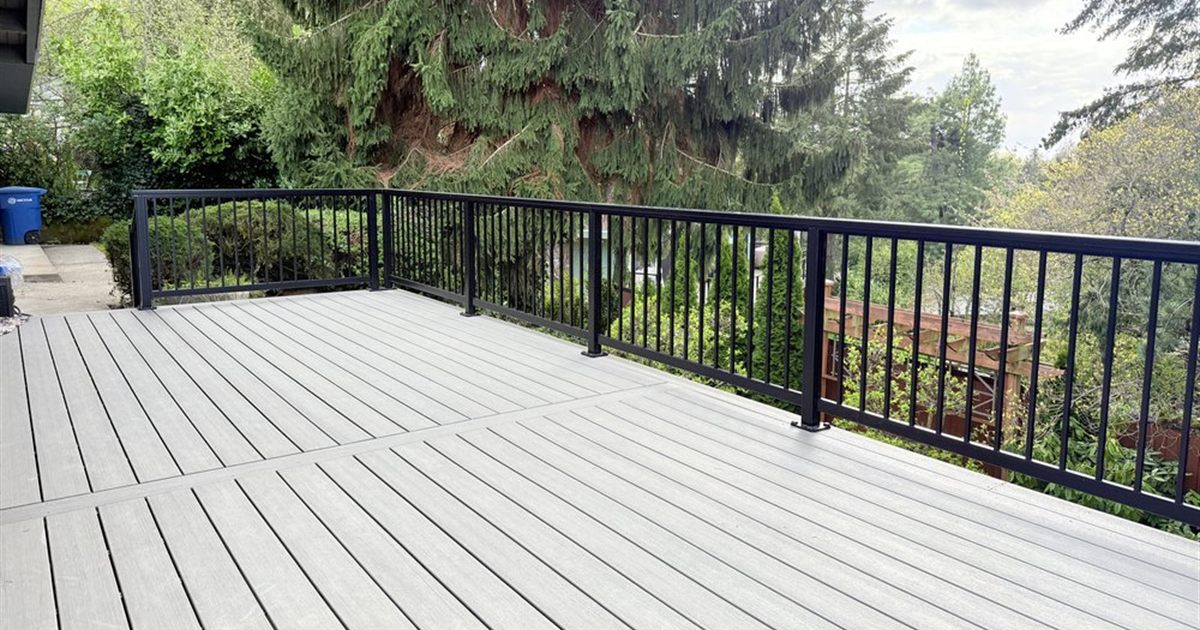
Trex vs TimberTech is the most common question we get once a Seattle homeowner has settled on composite, and the honest answer is that both are excellent, and the line you pick within each brand matters more than the logo on the box. We hold both credentials (TrexPro Platinum and TimberTech Pro certified), we install both every month across Seattle, and neither pays us to say nice things. Here’s how they actually compare in a climate that dumps 37 inches of rain a year on your deck.
The Two Lineups in Plain English
Both companies sell good-better-best tiers, and comparing “Trex vs TimberTech” without naming the tier is how people end up with mismatched quotes.
Trex (trex.com) runs from Trex Enhance (entry, scalloped-bottom boards) through Trex Select and Transcend, up to Transcend Lineage and Signature at the premium end. All are wood-plastic composite with a polymer cap, and Trex builds its boards with ~95% recycled content, a genuine point of pride for a lot of our clients.
TimberTech (timbertech.com) sells three families: Edge (entry composite), Pro (mid/upper composite), and AZEK, which isn’t composite at all but 100% PVC with no wood fiber in it. That last one matters in the PNW, and it’s TimberTech’s structural advantage in this comparison: their top shelf is a fundamentally more moisture-proof board. (If AZEK-style PVC is where you’re leaning, our PVC vs. composite breakdown goes deeper.)
Head to Head
| Trex | TimberTech | |
|---|---|---|
| Entry line | Enhance: light, affordable, 3-side cap | Edge: similar class, 3-side cap |
| Mid/premium composite | Select / Transcend / Lineage | Pro (Terrain, Reserve, Legacy) |
| Top shelf | Signature (composite) | AZEK (100% PVC) |
| Capping on premium lines | 3-sided (uncapped bottom) | Pro: 4-sided; AZEK: full polymer board |
| Fade & stain warranty | 25–50 yrs by line | 25 yrs (Edge) to 50 yrs + lifetime product (AZEK)* |
| Look/texture range | Consistent, familiar | Wider grain variation, matte finishes |
| Recycled content | ~95% | High on composite lines; AZEK ~54% |
| Typical installed price (Seattle) | $45–$75/sq ft | $45–$85/sq ft (AZEK at the top) |
*Warranty terms change by line and year, we confirm the current documents for whichever board you pick before contract.
Capping: The Detail That Matters Most in the PNW
A composite board is a wood-flour core in a polymer shell, and the shell is what keeps Seattle’s rain out. Trex caps three sides of its boards, leaving the bottom uncapped; TimberTech caps all four sides on its Pro line. In Arizona, that’s trivia. In Seattle (where the underside of your deck lives above damp soil in 80%+ winter humidity) four-sided capping is a real, physical advantage for the board’s core.
Does that mean Trex boards fail here? No, we’ve got Trex decks over a decade old performing beautifully, and the cores are engineered to tolerate moisture. But when a client’s deck is low to the ground, shaded, or near water, the four-sided cap (or AZEK, which has no wood to protect at all) is what we recommend, and moisture is the reason.
Fade, Heat, and Color
Both brands’ premium boards hold color impressively in Seattle, our UV load is modest by national standards, and fade complaints here are rare with either. Fade-and-stain warranties run 25 years on entry lines up to 50 on premium lines from both makers.
Heat separates them slightly: AZEK’s PVC construction reflects more heat than wood-filled composite, and TimberTech advertises it running up to 30° cooler than comparable composites, worth having on a south- or west-facing Seattle deck that catches full July sun. On the flip side, Trex Transcend’s color palette and streaking pattern is, to a lot of eyes, the most convincing “wood from ten feet” in the composite category. This one’s personal: look at physical samples on your actual site, in Seattle light, not showroom light.
How They Age Here: Year 5 and Year 10
Spec sheets are written in labs; decks live outside. Here’s what our repair and maintenance calls actually show on both brands in Seattle.
Year 5: honestly, nothing separates them. Premium lines from both brands look close to new after a spring wash. Entry lines (Enhance, Edge) show slightly more surface wear at high-traffic spots (door thresholds, stair treads) on both brands equally. The failures we do see at year 5 are installation failures: buckled boards from missing expansion gaps, corroded coated fasteners, mushy framing under a beautiful surface. Brand-agnostic, every time.
Year 10: color has softened a shade on both, noticeable only if you hold a spare board against the deck. Texture differences start to matter: the deeper embossing on TimberTech Pro and Trex Transcend hides wear better than the shallower grain of entry lines. Boards near grills show it most. We have not yet replaced a major-brand capped board for rot, swelling, or delamination in Seattle. That sentence is the entire case for capped boards in this climate.
What kills composite decks here isn’t the composite, it’s what’s under it. Which is why we’d rather install your second-choice board over a properly built frame than your first choice over a bad one.
Railings, Fasteners, and the Rest of the System
You’re not just picking boards, both brands sell matching railing, fascia, and hidden-fastener systems, and mixing brands mid-deck gets awkward on color matching and warranty coverage. Two practical notes from our install crews:
- Hidden fasteners: both brands’ grooved-edge boards take clip systems that leave a screw-free surface. In Seattle we insist the clips be stainless steel, not coated carbon, coated clips are a known corrosion point in year-round moisture, and they’re buried under your boards where you’ll never see the failure coming.
- Railing: TimberTech’s aluminum and composite railing lines and Trex’s railing families both integrate cleanly with their own decking. If you want black aluminum rail over composite boards (the most-requested combo in Seattle right now for preserving views) both brands support it well, so railing rarely tips the brand decision.
Price and Value
Like-for-like tiers are close enough that price shouldn’t pick the brand: entry lines from both land a typical 300 sq ft Seattle build in the $13,500–$18,000 range, premium composite lines $18,000–$25,000, and AZEK a step above that. Availability sometimes decides it, one brand’s color you love may be stocked locally while the other special-orders in three weeks.
Where the money conversation gets real is tier-jumping: moving from Trex Enhance to Transcend, or TimberTech Edge to Pro, buys you thicker capping, better texture, and a longer warranty for roughly $8–$15 more per square foot installed. In this climate, we think the mid-tier jump is worth it more often than not.
Warranty Fine Print Worth Five Minutes of Your Life
Both brands’ warranties are genuinely good and genuinely full of conditions. The parts that actually matter:
- Fade coverage has a threshold. Warranties cover fade beyond a defined amount (measured in color-change units), not “any fade.” Normal, even weathering across the whole deck typically isn’t a claim; blotchy or premature failure is.
- Stain claims have a clock. Most stain coverage requires cleaning the spill within a stated window (commonly a week or two). BBQ grease left all summer isn’t covered on anyone’s deck.
- Labor usually isn’t included, a standard warranty replaces boards, not the cost of removing and reinstalling them. This is where certified-installer programs earn their keep: installs through TrexPro and TimberTech certified contractors qualify for enhanced warranties that add labor coverage for a period. It’s a real financial difference, not a sales badge.
- Register it and keep the receipt. Unregistered warranties and missing proof of purchase are the two most common reasons valid claims stall.
We register every warranty for our clients at handoff and archive the purchase records, ten years from now, nobody remembers which SKU their deck was.
Our Verdict
- Best budget board: toss-up, Trex Enhance and TimberTech Edge are the same class. Pick by color and availability.
- Best all-around Seattle composite: TimberTech Pro, by a nose, on four-sided capping. Trex Transcend is right behind it and wins on looks for many clients.
- Best board for wet, shaded, waterfront, or rooftop sites: TimberTech AZEK, no wood in the board means no moisture story at all.
- Best if sustainability leads: Trex, on recycled content.
There’s no wrong answer between these two, which is exactly why we carry both certifications. For how composite as a category compares to cedar, IPE, and PVC, start with our full best decking material for Seattle’s wet climate guide.
Frequently Asked Questions
Is Trex or TimberTech better for rainy climates?
Both perform well, but TimberTech has the edge on paper for a rainy climate: its Pro line caps all four sides of the board, and its AZEK line is 100% PVC with no wood fiber to absorb moisture. Trex’s three-side-capped boards still perform reliably in Seattle when installed with proper drainage and ventilation.
Is TimberTech more expensive than Trex?
At matching tiers, no, entry and mid lines price within a few dollars per square foot of each other. TimberTech’s range tops out higher only because AZEK is a PVC product, which costs more than any composite.
How long do Trex and TimberTech decks last?
Realistically 25–30+ years in the PNW. Both brands back their boards with fade-and-stain warranties from 25 years on entry lines to 50 years on premium lines; TimberTech AZEK adds a lifetime limited product warranty. Confirm current terms for your specific board before you buy.
Are Trex and TimberTech slippery in Seattle rain?
Both brands’ current textured boards perform comparably to wood when wet, and better than smooth-worn old lumber. No deck surface is slip-proof in a Seattle November, board texture and keeping the surface free of algae film matter more than the brand. Deeper-grained premium lines give slightly better grip than smoother entry lines.
Does it matter who installs the composite deck?
More than the brand does. Composite warranties assume correct gapping, fastening, and ventilation, and Seattle’s moisture punishes shortcuts on framing, flashing, and fasteners underneath the boards. A certified installer also gets you enhanced labor warranty options that box-store installs don’t.
Get Both Priced by a Crew Certified in Both
We’re one of the few Seattle outfits holding TrexPro Platinum and TimberTech Pro certification at the same time, 1,250+ decks built across the city since 2008, in-house crew, SDCI permits handled, 10-year transferable structural warranty. See our Trex installation service and TimberTech builds for specifics.
Call (425) 928-1172 for a free same-day on-site quote, we’ll bring samples of both brands and price your top pick from each, side by side.