
Rotted Deck Joists: How Serious It Is and What Your Repair Options Are
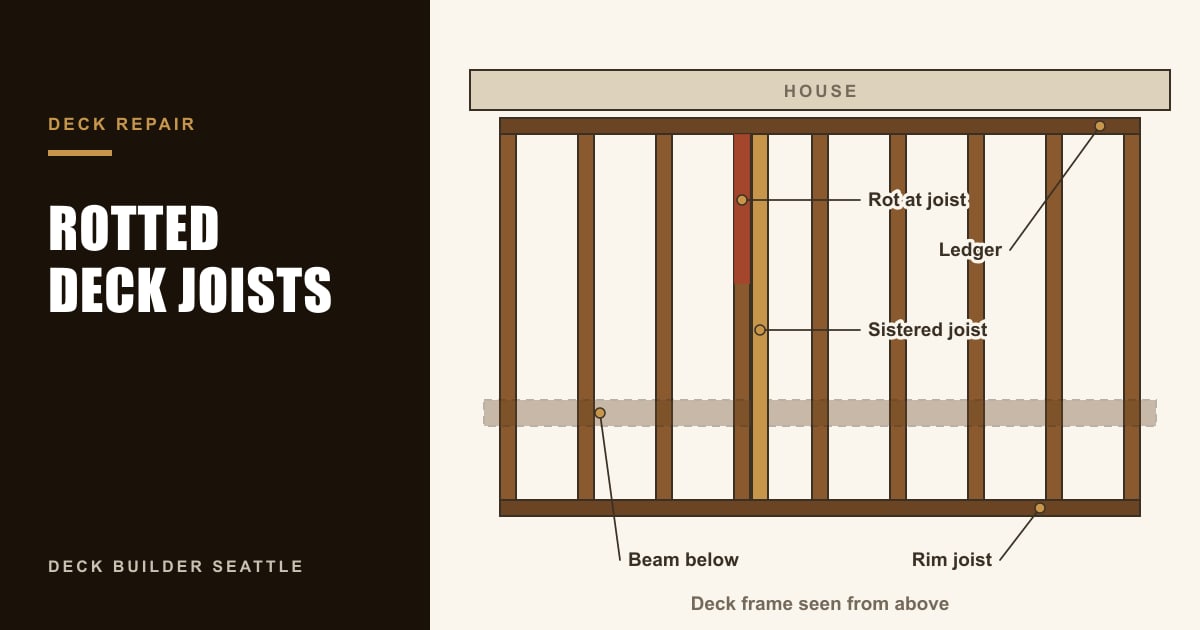
Rotted deck joists are a structural problem. Joists carry the weight of the deck boards and everyone standing on them, so decay in a joist reduces the strength of the deck itself. Limited rot in a few joists can usually be repaired by reinforcing or replacing those members. Rot spread across many joists, or at the connection to the house, generally means a larger section of the frame needs to be rebuilt.
How serious it is depends on three things: how deep the decay goes, where along the joist it is, and how many joists are affected.
This guide explains how joists rot, how the damage is assessed, and what each repair approach involves. It describes the repairs so you can understand a contractor’s recommendation. It is not a set of instructions for altering load-bearing framing yourself.
What joists do, and why joist rot is different from board rot
Joists are the horizontal framing members that run under the deck boards, commonly 12 to 24 inches apart. On a deck attached to a house, each joist is supported at one end by the ledger, the board fastened to the house, and at or near the other end by a beam that sits on posts.
A rotted deck board is a surface problem. Remove it, screw down a new one, and the deck is as strong as before.
A rotted joist is part of the structure. Its neighbors pick up the load it can no longer carry, the deck boards above it lose their support, and the fasteners driven into it stop holding. If the decay is at the end of the joist, the connection to the ledger or beam is compromised.
Joist rot is also harder to see. Decking wears in plain view. Joists decay under the boards, from the top down.
Where deck joists rot
Decay needs wood that stays wet. On a joist, a few locations reliably do.
The top edge under the deck boards
Water runs through the gaps between boards and lands on the top of each joist. Where a board sits on the joist, the water is held in the seam by capillary action, along with fine debris. The top edge can stay damp for weeks while the sides of the joist look dry.
This is the most common pattern: a joist that looks fine from below and is soft along the top inch or two.
Around fasteners
Every screw or nail through a deck board makes a hole in the top of the joist. Water follows the fastener into the wood. Over years, and especially after a deck has been re-screwed, the top of the joist becomes a line of small wet pockets. Fasteners that have lost their grip are an early sign.
Joist ends
End grain absorbs water readily. The cut ends of joists sit against the ledger at one end and the rim joist at the other, in tight joints that dry slowly. Metal joist hangers can cup water against the end of the joist as well.
Rot at a joist end is more serious than the same amount of rot at mid-span, because the end is where the joist’s load transfers to its support.
Beam connections
Where joists rest on top of a beam, the contact surface between the two pieces of wood traps moisture. Debris collects there too. Decay at this bearing point affects both the joist and the top of the beam.
Ledger areas
If the flashing above the ledger is missing or has failed, water runs down the wall and into the joint between the ledger and the house. The ledger, the joist ends attached to it, and the house framing behind it can all be wet. Joist rot concentrated along the house side of the deck should always prompt a close look at the ledger.
Other trouble spots
- Under planters, mats, and built-in benches, where the decking never dries
- Doubled joists and blocking, where two pieces of wood are sandwiched together
- Low decks with little clearance, where air cannot move under the frame
- Decks with a ceiling or drainage system installed underneath, which can hold humidity against the framing if it was not detailed to ventilate
Why some treated joists rot anyway
Deck framing is normally pressure-treated lumber, which resists decay. It still fails in certain situations.
Cut ends and holes. Preservative penetrates the outer part of the lumber best. A saw cut, notch, or drilled hole can expose less-protected wood. The residential code requires field-cut ends, notches, and drilled holes in treated wood to be treated on site, and an end-cut preservative such as copper naphthenate is the usual product. On many older decks this step was skipped.
The wrong treatment rating. Treated lumber is sold in use categories. Lumber rated for above-ground use holds less preservative than lumber rated for ground contact. Industry standards from the American Wood Protection Association call for the ground-contact rating on joists and beams that are difficult to maintain, repair, or replace and are critical to the structure, and on framing that is close to the ground, poorly ventilated, or frequently wet.
Constant moisture. No treatment makes wood immune. A joist that stays saturated for years will eventually decay.
How rot severity is evaluated
An assessment looks at several things together. No single measurement decides the outcome.
Depth. Is the decay limited to a thin layer at the top surface, or does it extend well into the joist? A joist’s strength depends heavily on its full depth, so decay that reduces the depth has an outsized effect.
Length. A soft spot a few inches long has a local cause. Softness running along several feet of the joist means the whole top edge has been wet.
Location. Decay at the ends, where the joist bears on a hanger or a beam, is treated more seriously than the same amount at mid-span. Decay near the middle of a long span matters because that is where bending stress is highest.
Number and pattern. One or two joists under a planter is a contained problem. Every second joist showing softness means the conditions that caused it exist across the frame.
Connections. Are the hangers corroded? Is the ledger sound? Is the beam under the joists affected?
Cause. A repair only lasts if the source of moisture is identified and corrected.
Assessment involves looking at the underside, probing the framing at the locations above, and checking fastener hold. The top edges of the joists cannot be fully seen until deck boards are removed, so the first assessment is always partly an estimate. Our guide on how to tell if deck wood is rotted explains what probing shows.
Repair options for rotted deck joists
There are four levels of repair. A contractor chooses among them based on the assessment.
| Approach | What it means | Fits when | Does not fit when |
|---|---|---|---|
| Sistering | A new full-size joist is fastened alongside the damaged one | Decay is limited and both ends of the new joist can be properly supported | Rot is at the bearing ends, runs most of the length, or affects many joists |
| Partial joist replacement | The damaged portion is cut out and a new section installed with support at the joint | Damage is confined to one end or section and a support can be provided where old meets new | No practical way to support the splice |
| Full joist replacement | The joist is removed and a new one installed from ledger to beam | A joist is decayed along its length or at its ends | Most joists need it, at which point reframing is more efficient |
| Larger framing replacement | A section of the frame, or the whole frame, is rebuilt | Decay is widespread, or the ledger or beams are also affected | The damage is isolated |
Sistering deck joists
Sistering means attaching a new joist to the side of an existing one so the two act together, or so the new one takes over the load.
For a sister to do real structural work, it generally has to be the same depth as the original, reach the supports at both ends, and be connected with a fastening pattern suited to the load. A short piece of lumber screwed over a soft spot is a patch, not a sister.
Two cautions apply. First, decayed wood left in place is still damp wood, and new lumber fastened tightly against it can be exposed to the same moisture. Industry guidance calls for ground-contact rated lumber when new components are in direct contact with older construction that shows decay. Loose, decayed material is normally removed and the area allowed to dry.
Second, sistering adds another wood-to-wood seam, which is itself a place for water to sit. It needs to be detailed so it drains.
Partial joist replacement
Sometimes only one end of a joist is damaged, often the end at the ledger. The decayed portion can be cut back to sound wood and a new section installed.
The joint between old and new wood has to be supported, because a joist cannot simply be spliced in mid-air. That usually means adding a beam, a header, or posts beneath the joint. Whether this is practical depends on the layout under the deck.
How deck joists are replaced
Full replacement removes the damaged joist and installs a new one between the ledger and the beam.
In outline, the deck boards above are removed, or the fasteners into that joist are released from below where that is possible. The deck is supported as needed, the old joist and its hangers are taken out, a new treated joist is set with new corrosion-resistant hangers and fasteners, cut ends are treated, and the decking is reinstalled.
The work is straightforward for an experienced crew and risky for an inexperienced one. Removing a joist changes how load moves through the frame. On a raised deck, or where the ledger is involved, temporary shoring is part of the job.
When larger framing replacement is required
At some point, repairing joists one by one stops making sense. That is typically the case when:
- A large share of the joists show decay along their top edges
- Rot is concentrated at the ledger, and the ledger or the house framing behind it is affected
- The beam or posts are decayed as well
- The frame was undersized or poorly connected to begin with
- The decking is coming off anyway for resurfacing, and the frame would not outlast the new boards
When repairs reach this scale, the decision becomes whether to rebuild the frame or the whole deck. Our guide on whether to repair or replace a deck covers that choice.
Joist tape: prevention, not a cure
Joist tape is a self-adhesive flashing tape, usually butyl or asphalt based, applied along the top edge of joists and beams before the deck boards go on. It sheds water off the top of the joist and seals around fasteners that pass through it.
It addresses the exact spot where most joist rot begins, which is why many builders use it on new decks and when resurfacing. The residential code does not require it. The code does include a general specification for flashing materials on decks, and manufacturers publish their own performance claims.
What joist tape cannot do is repair anything. Applied over wood that is already soft, it hides the damage. Applied over damp wood, it can slow drying. Tape belongs on sound, dry framing.
Deck joist rot treatment
People often ask whether rotted joists can be treated in place. It helps to separate three ideas.
Preservative on sound wood is worthwhile. Brush-on preservatives protect cut ends, drilled holes, and freshly exposed surfaces, and they are appropriate on sound wood next to an area that has been repaired.
Preservative on decayed wood can slow further fungal activity in that spot. It does not restore the strength that has been lost. A joist that is soft is weak, whatever is brushed onto it.
Hardeners and epoxy fillers are made for trim and non-structural parts. They are not an accepted repair for load-bearing framing.
The treatment that works is the unglamorous one: remove or reinforce the damaged member, correct the source of water, and let the framing dry.
Why this is not a typical DIY repair
Replacing a deck board is a reasonable homeowner project. Structural framing repair is a different category.
- The deck may need temporary support while members are removed, and the consequences of getting that wrong on a raised deck are severe
- New members have to be sized for the loads the code requires, which in Washington is a 60 pound per square foot live load for decks
- Hangers and fasteners must be the correct type, corrosion-resistant, and installed in every specified hole
- Rot at the joist ends often leads into the ledger connection, the part of a deck where mistakes matter most
- In Seattle, work on load-bearing supports falls outside the minor repair exemption, so a permit may be required
If you have found soft joists, the useful steps for a homeowner are to keep weight off the area, note where the damage is, clear debris so the framing can dry, and have the structure assessed.
What repair costs
Joist repairs are priced by the number of joists and by how hard they are to reach. Reinforcing or replacing individual joists costs far less than rebuilding a ledger or reframing the deck. Our deck repair cost guide gives 2026 planning ranges for each type of repair and explains why quotes can change once the decking is removed.
Getting the framing assessed
An accurate recommendation depends on seeing the underside of the deck and probing the joists at their ends, along the top edges where they can be reached, and at the beam.
Ask the person assessing it to tell you how many joists are affected, where on each joist the decay is, what caused it, and which of the four repair approaches they recommend and why.
Our deck repair service in Seattle page explains how we inspect framing and how we report what can be repaired and what should be replaced.
Frequently Asked Questions
Is it safe to use a deck with a rotted joist?
Treat it as unsafe in the affected area until someone has assessed it. One decayed joist in the middle of a deck may leave the rest of the structure working, but you cannot tell from above how deep the decay goes or whether neighboring joists and the ledger are affected. Keep people and furniture off that section, and stay off the whole deck if the rot is at the ledger or the deck is raised well off the ground.
Can you sister a rotted deck joist instead of replacing it?
Sometimes. Sistering works when the decay is limited, the original joist still has sound wood at its bearing points, and the new joist can be supported properly at both ends so it carries the load by itself. It is a poor choice when the joist is decayed along most of its length or at its ends, when the cause of the moisture has not been fixed, or when many joists are affected.
Is joist tape worth it?
On new framing or during a resurfacing, it is inexpensive protection for the part of the joist most prone to decay. Manufacturers state that it keeps water off the top of the joist and seals around fasteners. It is not required by the residential code, and it does nothing for wood that is already decayed. Tape applied over soft or damp wood covers the problem and can slow drying.
How long do deck joists last?
There is no fixed lifespan. Pressure-treated joists that can drain and dry commonly last several decades. The same lumber on a deck built close to the ground, with debris packed between boards and no airflow underneath, can show decay far sooner. Flashing, drainage, ventilation, and the treatment rating of the lumber matter more than the calendar.
Do I need a permit to replace deck joists in Seattle?
Possibly. Seattle exempts minor repairs valued at $6,000 or less in a six-month period and in-kind replacement of deteriorated members, but the exemption does not cover removal, alteration, or relocation of load-bearing supports. Joists are load-bearing, and SDCI does not publish a deck-specific ruling. Ask SDCI how it applies to your scope before work starts, particularly if the ledger or beams are involved.
If you are seeing structural damage, an assessment can determine how much of the framing can realistically be repaired.
Deck repair service or call (425) 928-1172