
Repair or Replace a Deck? A Decision Guide for Seattle Homeowners
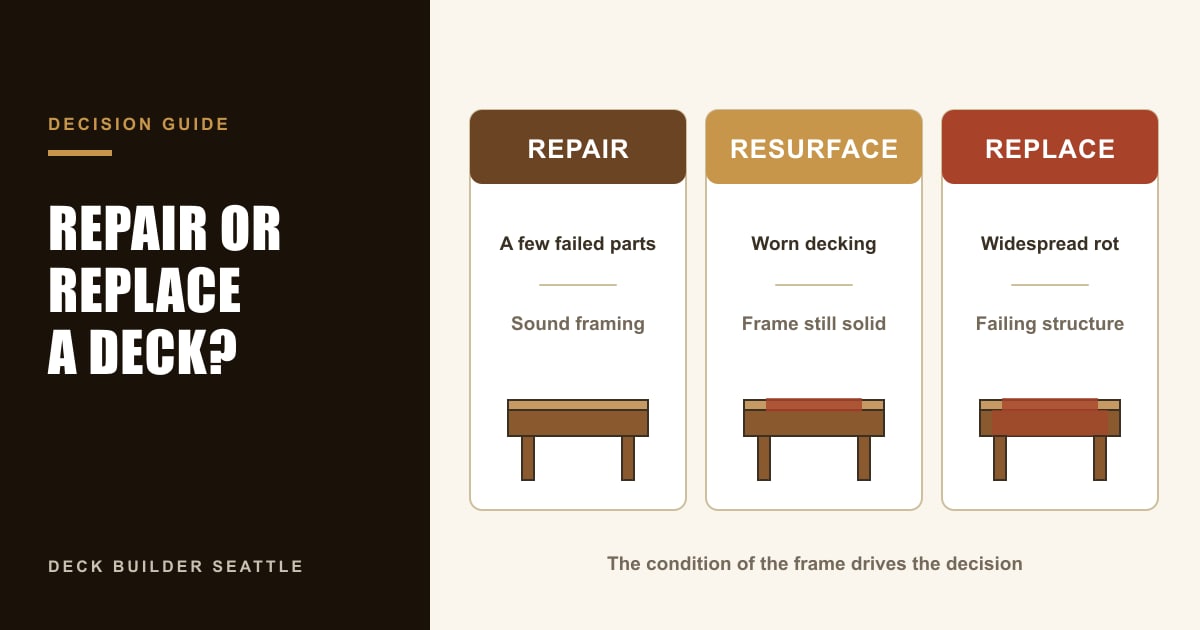
Whether to repair or replace a deck comes down to the frame. If the joists, beams, ledger, posts, and footings are sound, repair or resurfacing almost always makes financial sense. If rot or movement has spread through the structure, new boards and railings end up fastened to a failing frame, and replacement is the better use of the money.
Age and appearance come second. A gray, splintery 20-year-old deck on a solid frame can be a good resurfacing candidate. A 12-year-old deck with a rotted ledger may not be worth saving.
This guide walks through the five realistic options, the conditions that push a deck from one to the next, and how to get a reliable answer for your own deck.
The five options, from smallest to largest
Most homeowners think of this as a two-way choice. In practice there are five levels of work, and the right one depends on how deep the damage goes.
| Option | What it involves | Fits when | Poor fit when |
|---|---|---|---|
| Minor repair | Swapping a few deck boards, tightening or replacing fasteners, fixing one railing section or a stair tread | Damage is isolated and the cause is obvious, like one board under a planter | The same problem keeps appearing in new spots |
| Major repair | Repairing or reinforcing framing: a few joists, a stair stringer, post bases, part of a beam | Structural damage is limited to a defined area and the rest of the frame tests sound | Rot is present at the ledger, across many joists, or at several posts |
| Resurfacing | Removing all decking and usually the railing, keeping the frame, installing new boards and rail | The frame is sound, flat, and correctly spaced for the new decking | Framing is undersized, decayed, or near the end of its life |
| Structural rebuild | Replacing a large portion of the frame, such as all joists or the ledger and beam, while keeping footings or layout | Footings and posts are good and the layout works, but the framing has failed | Footings have settled or the layout no longer suits the house |
| Complete replacement | Tear-out to the ground, new footings, frame, decking, railing, and stairs | Deterioration is widespread, or the design, size, or height needs to change | The frame is still healthy and only the surface is worn |
Some terms, since they come up in every estimate. Decking is the boards you walk on. Joists are the horizontal framing members under the decking that carry it. Beams carry the joists, posts carry the beams, and footings are the concrete bases that carry the posts.
The ledger is the board that fastens the deck to the house. Resurfacing (also called re-decking) means new boards on the old frame, while rebuilding means new structure.
Why the frame decides whether to repair or replace a deck
Decking and railings are replaceable parts. The frame is what holds people up, and it is also the part you cannot see well from above.
A contractor assessing a deck is really answering one question: will this structure safely outlast whatever we attach to it? New composite boards are commonly warranted for 25 years or more. Fastening them to joists that have ten years left creates a deck that will need to be taken apart in the middle of its surface life.
Ledger condition
The ledger connection carries a large share of the load on a typical attached deck, and it sits exactly where water tends to collect. If the flashing above the ledger is missing or failed, water runs behind the board and into the house’s rim framing.
A ledger that is soft, stained dark, pulling away from the wall, or attached only with nails is a serious finding. Replacing a ledger is possible as a repair, but once the house framing behind it is wet too, the scope grows quickly and replacement of the deck often makes more sense.
Joist rot
Joists usually rot from the top down, where water sits under the deck boards and around every fastener hole. A few affected joists can be reinforced or replaced. Our guide to how to tell if deck wood is rotted covers what to look for.
The pattern matters more than the count. Rot in two joists below a leaking planter has a local cause. Soft tops on joists spread across the whole deck means the framing has been wet for years, and the joists that still feel firm are not far behind.
Posts and footings
Posts that sit in soil or in a pocket of concrete often decay at the base, right at ground level. Footings can settle or tilt, especially on Seattle’s sloped lots and in fill soil.
A deck that has dropped at one corner, or a post that leans, points to a problem below the frame. New decking does nothing for that. If footings need to be replaced, the work is already most of the way to a full replacement.
How each factor shifts the decision
No single factor settles the question. They add up.
Age. Age alone is a weak signal. What matters is how the deck was built and whether it could dry out. A well-flashed, well-ventilated frame can outlive its first set of boards. A deck built low to the ground with no airflow can be in poor shape in half that time.
Percentage of decking that needs replacing. You will see rules online such as “replace the deck if more than a certain share of the boards are bad.” There is no code or engineering basis for a specific percentage. The practical point is about labor and appearance: once a large share of the boards are being swapped, the cost approaches a full resurfacing, and the result is a patchwork of old and new boards that weather differently.
Railing condition. A loose railing is often a connection problem, and it can be repaired. If the railing posts are rotted where they attach to the frame, check the rim joist they are bolted to. Damage there usually signals wider moisture problems.
Recurring repairs. One repair in fifteen years is maintenance. A repair every year or two means the deck is wearing out as a system. Add up what you have spent over the past five years before approving the next fix.
Desired material upgrade. Moving from wood to composite or PVC changes the requirements for the frame. Manufacturers specify maximum joist spacing, and many boards need joists at 16 inches on center or closer. If the existing frame is spaced wider, it needs added joists or a rebuild.
Current layout. If the deck is too small, has stairs in the wrong place, or blocks a view from the house, repairing it preserves a layout you already dislike. Replacement is the point where size, shape, and height can change.
Code-related issues. Many older decks were built to earlier standards, or without a permit. A repair does not automatically require bringing the whole deck up to current code, but new work has to comply, and visible hazards such as low or widely spaced guards and missing ledger fasteners are worth correcting regardless. When the list of corrections gets long, rebuilding is usually simpler than retrofitting piece by piece.
Deck resurfacing vs replacing
Resurfacing is the middle path, and it is the option homeowners most often overlook. When it works, it delivers a deck that looks and feels new for noticeably less than a rebuild.
It works when the frame passes four checks:
- The joists, beams, and ledger are free of decay, including on the top edges that are hidden until the old boards come off
- The frame is flat and level enough for new boards to sit properly
- Joist spacing suits the new decking product
- Posts and footings are stable, with no settlement or leaning
The catch is that the most important check cannot be finished until the old decking is removed. A resurfacing quote should say what happens if hidden damage turns up: which repairs are included, and what each additional joist or section of ledger would cost.
Sound framing may allow resurfacing. Widespread structural deterioration makes replacement the more sensible choice, even though the first quote is higher.
Three homeowner scenarios
A cedar deck in Ballard, 14 years old. The boards are gray and cupped and a few are soft at the ends. The frame is pressure-treated, well off the ground, and dry underneath. The ledger is flashed. This deck is a strong resurfacing candidate, with a small allowance for joist repair.
A second-story deck in West Seattle, 22 years old. The stairs wobble, two posts are soft at the base, and there is dark staining on the siding below the ledger. Each problem could be repaired separately, but together they describe a frame with water damage at the top, bottom, and connection. Replacement is the realistic answer.
A low deck in Wallingford, 9 years old. One corner bounces. Underneath, one joist has split at a large knot and the rest look clean. This is a major repair on an otherwise healthy deck, and replacing it would waste a good structure.
What the cost comparison looks like
Repair is priced by the component, so a small job can be a few hundred dollars and a structural one can reach several thousand. Our deck repair cost guide breaks that down by part.
Replacement is priced by the project and includes demolition, disposal, new framing, and usually a permit. The deck replacement cost guide covers each of those line items and shows where resurfacing lands between the two.
A useful comparison is cost per year of remaining life. A repair that buys three years on a tired frame can cost more per year than a replacement that lasts twenty-five.
When to replace a deck without much debate
Some findings settle the question on their own. Plan for replacement, or at least a structural rebuild, when an inspection finds any of these:
- Rot in the ledger together with moisture damage in the house framing behind it
- Decay in a large share of the joists, or in the beams that carry them
- Several posts decayed at the base, or footings that have settled or shifted
- A frame that was undersized or poorly connected from the start, with no practical way to reinforce it
- Structural problems combined with a layout or height you already want to change
If you are asking “should I replace my deck” because it looks tired, the answer may well be no. If you are asking because it moves, sags, or feels soft, get it looked at before the next gathering on it.
Getting an answer for your own deck
A reliable recommendation takes a look at the underside, probing of the framing at the ledger, joist ends, and post bases, and a check of the connections and footings. Surface photos are not enough.
Ask whoever assesses it to tell you which of the five options they recommend and why the smaller options were ruled out. A good assessment explains what was found in the frame, not only what is wrong with the boards.
If the findings point toward a rebuild, our Seattle deck replacement service page explains how tear-out, permitting, and construction are handled. If they point toward repair, that is good news, and it is what we will recommend.
Frequently Asked Questions
Is it cheaper to repair or replace a deck?
Repair is cheaper when the problem is limited to a few boards, a railing section, or one or two framing members. Replacement becomes the better value when structural repairs start to stack up, because each one adds labor to a frame that still has the same age and exposure as the parts that already failed. Compare the repair quote plus the repairs you can reasonably expect in the next five years against the replacement price.
Can I put new composite decking on my old deck frame?
Only if the frame is sound and matches the decking manufacturer's installation instructions. Many composite and PVC boards call for joists spaced 16 inches on center or closer, and older wood decks were sometimes framed at 24 inches. The frame also needs to be flat, free of rot, and likely to outlast the new boards, which often carry 25-year or longer warranties.
How long should a deck last in Seattle?
There is no fixed number. A well-maintained cedar deck commonly lasts 15 to 25 years here, capped composite boards 25 to 30, and a pressure-treated frame can outlast the first set of decking if water drains and the wood can dry. Shade, tree cover, missing flashing, and skipped maintenance shorten all of those figures.
Should I replace my deck before selling my house?
Not automatically. Buyers and home inspectors mostly care about safety and structure, so fixing loose railings, failed stairs, and rotted framing usually matters more than new boards. If the deck has serious structural problems, get a written assessment and a quote so you can decide between replacing it, repairing it, or pricing the issue into the sale.
Can just one section of a deck be replaced?
Yes. A partial rebuild can replace a stair run, one bay of joists, a rotted beam, or the outer portion of a deck while keeping the rest. It works when the damage has a clear cause and a clear boundary. It works poorly when the same moisture problem is present across the whole frame and simply shows up first in one area.
If the frame is past saving, see how a full tear-out and rebuild works on our Seattle deck replacement page.
Deck replacement service or call (425) 928-1172