
Deck Repair Cost in Seattle (2026): Prices by Type of Repair
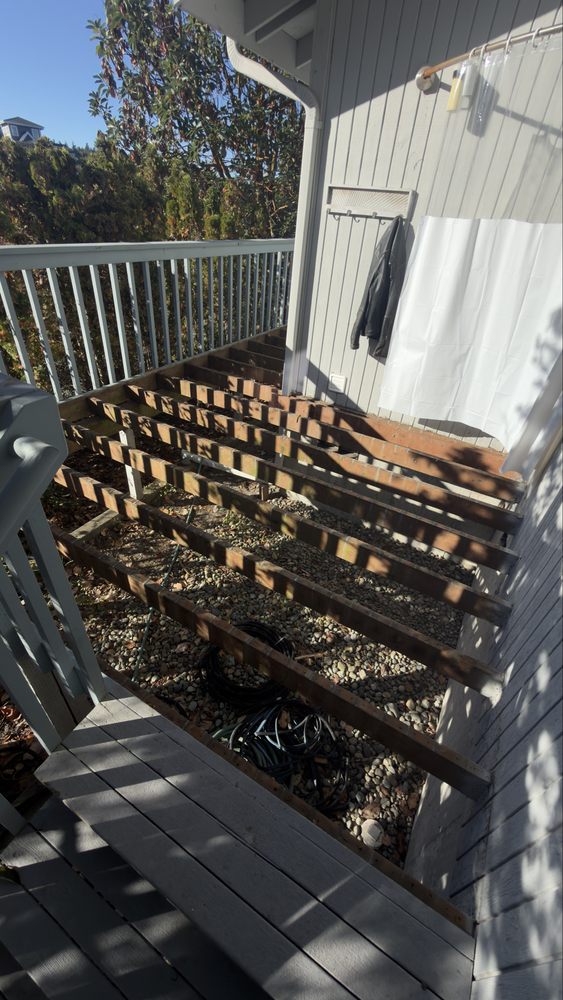
Deck repair cost in Seattle ranges from about $400 for a small fix to $9,500 or more for structural work, as of 2026. Most of that spread comes from one question: is the damage in the surface or in the structure?
Replacing a few boards or tightening a railing is a few hours of work. Repairing joists, a beam, or the ledger that ties the deck to the house involves temporary support, removal of the decking above, and sometimes repairs to the house wall. Those jobs cost several times more.
The ranges in this guide are planning estimates based on our 2026 pricing. They are not quotes, and the right figure for your deck depends on its height, access, materials, and what is found once work begins.
Deck repair cost in Seattle by type of repair
A deck repair is priced by the component being fixed. This table gives typical scopes and the conditions that push each one higher.
| Repair | Typical scope | 2026 planning range | What increases cost |
|---|---|---|---|
| Isolated deck boards | Replacing up to about ten boards | $400 to $900 | Matching discontinued composite, hidden fasteners, boards under railings |
| Larger decking replacement | New decking on the existing frame | $20 to $50 per sq ft | Composite or PVC, borders and patterns, frame corrections |
| Railing repair | Resecuring or replacing posts and a rail section | $300 to $1,200 | Rotted rim joist behind the posts, custom or glass systems |
| Stair repair | New treads, repaired or replaced stringers | $300 to $1,500; a rebuilt flight $1,500 to $4,000 | Height, landings, handrail and guard upgrades |
| Joist repair | Reinforcing or replacing individual joists | $250 to $700 per joist; $1,500 to $5,000 for a typical job | Poor access from below, rot at the ledger end, decking removal |
| Beam repair | Replacing a section or a full beam with temporary shoring | $1,000 to $4,000 | Deck height, span, post replacement at the same time |
| Post and post base | Replacing a decayed post and its connector | $400 to $1,200 per post | New footing required, tall posts, limited access |
| Ledger repair | Replacing ledger sections, flashing, and fasteners | $1,500 to $6,000 or more | Damage to the house rim framing, siding removal, full-length replacement |
| Hardware and fasteners | Replacing corroded hangers, adding bolts and hold-downs | $300 to $1,500 | Number of connections, stainless hardware near salt water |
Combined jobs are common. A repair that covers a section of boards plus railing work typically falls between $1,800 and $4,200. Structural repairs involving several joists or a ledger commonly land between $4,800 and $7,500.
Cost to replace deck boards
Decking is the layer of boards you walk on. It takes the weather directly and is usually the first part of a deck to show wear.
A few boards
Replacing isolated boards is the smallest deck repair. The material cost is minor. What you are paying for is the trip, the setup, and the care needed to remove fasteners without damaging the neighboring boards or the joists.
That is why the cost per board drops quickly as the count rises. Three boards and ten boards can cost nearly the same.
New wood will not match weathered wood at first. Cedar grays within a season or two and blends in. Composite is harder: colors are discontinued over time and older boards fade, so a patch on a composite deck can stay visible.
Deck board replacement cost for the whole surface
When most of the surface is worn, replacing all the decking on the existing frame is called resurfacing. In 2026 this typically runs $20 to $50 per square foot in Seattle, depending on the new material.
Resurfacing only makes sense if the frame beneath is sound. Before quoting it, a contractor should inspect the underside. Before finishing it, they should check the tops of the joists once the old boards are off. Our guide on whether to repair or replace a deck explains when resurfacing is the right call.
Railing and stair repairs
A wobbly railing is often a connection problem. If the posts and the framing they attach to are solid, adding proper bolts and blocking can fix it for a few hundred dollars.
The price rises when the post is rotted at its base or the rim joist, the outer framing member it bolts to, has decayed. Then the repair includes framing work.
Replacing an entire railing is priced by length and type. Wood runs about $45 to $75 per linear foot installed, with aluminum, cable, and glass costing progressively more.
Stairs take a lot of wear, and they sit where water and soil meet. Replacing treads is simple. Replacing stringers, the angled boards that carry the treads, means rebuilding most of the stair. A new stair also has to meet current dimensions for risers, treads, and handrails.
Deck joist repair cost
Joists are the horizontal framing members that carry the deck boards. They are the most common location for structural rot, usually along the top edge where water sits under the decking.
There are three levels of joist repair:
- Reinforcing, often called sistering, where a new joist is fastened alongside one that has limited damage
- Replacing individual joists that are too far gone to reinforce
- Replacing a section of framing when several adjacent joists are affected
Per joist, the work typically costs $250 to $700. That figure assumes several are done together and the area is accessible. A single joist repaired as a standalone visit costs more per piece because of setup time.
The larger cost is usually access. Joists are reached either from below, if there is room to work, or from above by removing decking. On a low deck there may be no way in from below at all.
Our article on rotted deck joists explains how severity is judged and which repair fits which condition.
Beam and post repair
Beams carry the joists, and posts carry the beams. Because everything above depends on them, they cannot simply be removed and swapped.
A beam repair starts with temporary shoring to hold the deck while the damaged section is taken out. The higher the deck, the more shoring is involved, and the price follows.
Posts usually fail at the bottom, where they meet soil or sit in a pocket of wet concrete. Replacing a post and its metal base is a moderate repair. If the footing below has settled, cracked, or is undersized, a new footing is needed, which adds excavation and concrete and may bring in permit requirements.
Deck ledger repair cost
The ledger is the board that fastens the deck to the house. It carries a large share of the deck’s load, and it is the most consequential repair on this list.
Ledger problems fall into two groups:
Connection problems. The ledger is sound but was attached with nails, or with too few fasteners. Adding structural screws or bolts and hold-down hardware is a contained repair toward the lower end of the range.
Water damage. Flashing above the ledger was missing or failed, and water has been running behind it. The ledger is soft, and the house’s rim framing behind it may be too.
The second case is where costs climb. The repair can include supporting the deck temporarily, removing siding, replacing sections of the house’s framing, installing new flashing, and then a new ledger. A full-length ledger replacement with wall repair can exceed $6,000.
It is also the repair you cannot scope accurately from the outside. The extent of damage in the wall is only visible once the ledger comes off.
Localized rot
Small areas of rot are priced by the part they are in. A soft board end is a board replacement. A soft spot on a joist is a joist repair.
What matters for cost is whether the rot has a local cause, like a planter or a downspout discharging onto the deck, or whether it reflects moisture across the whole frame. Local causes produce local repairs. Our guide on how to tell if deck wood is rotted explains how to distinguish decay from surface weathering.
Stain, sealer, wood filler, and epoxy do not restore strength to structural members. They are not a lower-cost substitute for replacing decayed framing.
Access and demolition costs
Two decks with identical damage can have different repair prices because of what it takes to reach the damage.
- Height. Work on a second-story deck needs ladders, scaffolding, or shoring.
- Clearance below. A deck 12 inches off the ground cannot be worked on from underneath, so boards come up instead.
- Site access. Carrying lumber through a house or down a steep side yard adds hours.
- Removal and disposal. Old boards, railings, and framing have to be hauled away. On a repair this is usually a few hundred dollars. Removing an entire deck runs $800 to $2,500.
- What is in the way. Hot tubs, built-in benches, pergolas, and under-deck ceilings all have to be worked around or temporarily removed.
Why structural repair costs rise once the decking is off
This is the part of deck repair that frustrates homeowners most, so it is worth explaining plainly.
From below, you can see the sides and bottoms of the joists. You cannot see their top edges, which are covered by the deck boards, or the back of the ledger, which is against the house. Those hidden surfaces are exactly where water sits.
A contractor can probe from below and make an informed estimate. Only removing the boards shows the real condition. It is common to quote two joists and find five, or to open a ledger for refastening and discover it has decayed.
A well-written quote deals with this up front. Look for:
- A clear description of what was inspected and what could not be seen
- Unit prices for additional work, such as a price per added joist or per foot of ledger
- A point at which the contractor will stop and consult you before continuing
That structure keeps a repair from turning into an open-ended bill.
When a repair estimate becomes a replacement discussion
Sometimes the findings change the plan. A repair conversation should shift toward replacement when:
- Decay shows up in several structural areas at once, such as the ledger, multiple joists, and post bases
- The repair total approaches a large share of what a new deck would cost
- The frame was underbuilt from the start, with undersized joists or footings
- This is the third or fourth significant repair in a few years
- You already want a different size, height, or material
Paying for major structural repairs on a frame that is wearing out everywhere is rarely good value. The repair or replace guide walks through that decision.
How to get a deck repair priced accurately
Start with what you can observe. Note where the problem is, how long it has been there, and whether anything moves when you walk on it. Our deck safety checklist lists what to look for without putting yourself at risk.
Then ask for a quote that separates the repair into components, states what is assumed about hidden areas, and gives unit prices for extras. Compare bids on scope, not only on the bottom line.
If you are seeing soft framing, a loose ledger, or movement in the structure, a hands-on assessment is the first step. Our deck repair service in Seattle page explains how we inspect, what we report, and how repairs are quoted.
Frequently Asked Questions
How much does it cost to replace deck boards in Seattle?
As a 2026 planning figure, replacing a handful of boards usually costs $400 to $900, most of which is labor and the minimum charge for a visit. Replacing all the decking on a sound frame typically runs $20 to $50 per square foot, depending on whether the new boards are pressure-treated, cedar, composite, or PVC. Hidden-fastener systems and picture-frame borders sit toward the top of that range.
Does deck repair need a permit in Seattle?
Small in-kind repairs generally do not. The Seattle Residential Code exempts minor repairs valued at $6,000 or less in any six-month period, provided the work does not remove, alter, or relocate any load-bearing support. Replacing joists, beams, posts, or a ledger is work on load-bearing structure, so confirm with SDCI before starting. Properties in environmentally critical areas have stricter rules.
Why did my repair quote change after the old boards came off?
Because the tops of the joists and the face of the ledger cannot be inspected until the decking is removed, and that is where decay starts. A careful quote identifies this risk in advance and lists a price for each additional joist or foot of ledger. If a quote does not mention hidden conditions at all, ask how they will be handled before signing.
Is it worth repairing a 20-year-old deck?
It can be, if the frame is in good condition. Age matters less than whether the joists, beams, ledger, and posts are sound. A 20-year-old deck with a dry, solid frame can be a good candidate for new boards and railing. One with decay in several structural members is usually better replaced, because each repair adds cost to a structure that is near the end of its life.
How much does a deck inspection cost in Seattle?
A professional deck inspection in Seattle typically costs $185 to $385 in 2026, depending on the size and height of the deck and whether you need a written report for a real estate transaction. For a deck with suspected structural damage, an inspection before repair work is priced usually pays for itself by defining the scope.
Need a repair priced? Our Seattle deck repair page explains how we assess the damage and what a written quote covers.
Deck repair service or call (425) 928-1172