
Is My Deck Safe? 12 Signs a Deck Is Unsafe
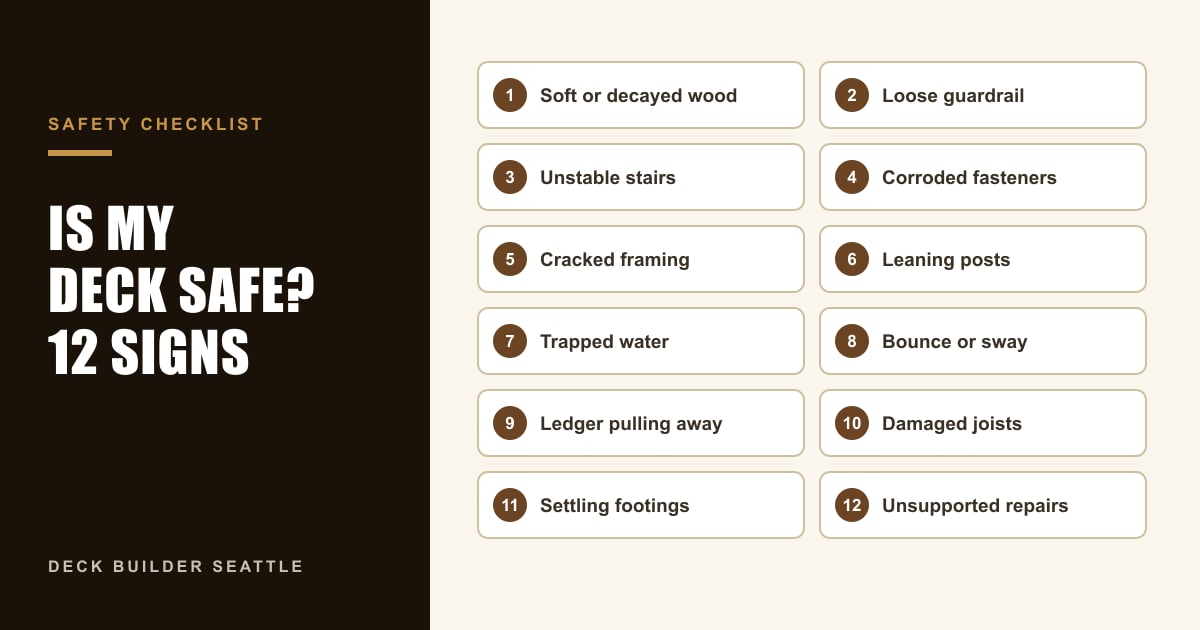
The clearest signs a deck is unsafe are soft or decayed wood, a ledger pulling away from the house, loose guardrails, unstable stairs, badly corroded fasteners, and a deck that moves when people walk on it. Any one of these is a reason to keep people off the affected area until the cause is known.
Most deck failures do not come from boards wearing out. They come from connections and framing that have been wet for a long time, in places that are hard to see from above. Seattle’s long wet season makes that kind of slow damage common, which is why a deck that looked fine in September deserves a look in April.
This deck safety checklist covers 12 signs. Eight are things you can check yourself from the surface and from the ground. Four are conditions where a homeowner can notice a symptom, but confirming the problem takes a professional inspection.
How to use this checklist safely
You need a flashlight, a screwdriver, and about twenty minutes. Walk the surface first, then look at the underside from the ground or from a lower level.
A few limits, because the point is to check the deck without making anything worse:
- Do not load-test the deck by jumping, rocking it, or gathering people on it
- Do not go under a deck that is visibly sagging, leaning, or separated from the house
- Do not remove boards, brackets, bolts, or trim to see behind them
- Do not stand on a ladder leaned against a railing or a post you have doubts about
If something looks wrong and you cannot see it clearly from a safe spot, note it and leave it for an inspector.
Eight signs a deck is unsafe that you can check yourself
1. Soft or decayed wood
Press the tip of a screwdriver against the wood in the places water sits: board ends, around fasteners, the tops of stair treads, and the base of posts. Sound wood resists the tip. Decayed wood lets it sink in easily, and the fibers break away in short, crumbly pieces.
Light pressure is enough. There is no need to stab at framing. Our guide on how to tell if deck wood is rotted explains what the results mean and how rot differs from surface weathering.
2. Loose guardrails
A guard (most people call it a railing) is the barrier at the edge of a raised deck. Grip the top rail at a post and push outward firmly with one hand. It should feel solid, with little movement at the base of the post.
The residential code requires a guard to resist a 200-pound load applied at the top in any direction. A post that rocks, or a rail section that flexes several inches, is far from that standard. Look at how the posts attach: bolts through solid framing are good, and nails or a couple of screws into the rim board are a common weak point.
3. Unstable stairs
Walk the stairs slowly while holding the handrail. Treads should not tip or flex, and the whole stair should not shift sideways.
Then look underneath. The stringers are the angled boards that carry the treads. Check that they are fastened to the deck with hardware and are not simply nailed through the end, that they rest on a solid surface at the bottom, and that they have no cracks running out from the notches.
4. Corroded fasteners and connectors
Look at the metal: joist hangers (the brackets that hold joists to the ledger or beam), bolts, screws, and post bases. Surface discoloration on galvanized steel is normal with age.
Heavy rust, flaking metal, hangers with missing fasteners, and nails that have backed out are not. Corrosion is faster where metal touches treated lumber that stays damp, and near salt water. A connector that has lost much of its thickness to rust has lost much of its strength.
5. Cracked or split framing
Small surface cracks along the grain, called checks, are a normal result of wood drying. They are usually cosmetic.
Be more concerned about a crack that runs across a joist or beam, a split that follows a line of fasteners, or a break starting at a notch or a large knot. Cracks at the ends of framing members, where the load transfers to a hanger or post, deserve particular attention.
6. Leaning posts
Stand back and sight along the posts under the deck. They should be vertical and should sit centered on their footings.
A post that leans, has shifted partly off its footing, or shows a gap at the top where it meets the beam means the support path has moved. Check the base of each post for softness as well, since posts decay first at ground level.
7. Water trapped around connections
Look for places where water has nowhere to go: leaves and dirt packed between boards over a joist, soil piled against posts, planters sitting directly on decking, and a ledger with no visible metal flashing above it.
Dark staining, green growth, and wood that still looks wet a day or two after rain mark the spots most likely to decay. This sign is about cause. Find these areas before the wood softens and many of them can be fixed with cleaning, drainage, or flashing.
8. Excessive movement
Walk the deck at a normal pace and pay attention to how it responds. Some spring across long spans is normal.
Movement that is new, noticeably worse in one area, or side to side instead of up and down is a warning. Sway on a raised deck often means missing bracing or a weak connection to the house. Do not try to make it move more to see how bad it is.
Four conditions that need a professional inspection
You may spot the symptoms below yourself. Confirming what is happening, and how serious it is, takes someone who can assess the structure, measure it, and in some cases open up the connection.
9. A ledger pulling away from the house
The ledger is the board that fastens the deck to the house. It carries a large share of the deck’s weight, and its failure is a common cause of sudden collapse.
Warning signs include a visible gap between the ledger and the wall, a deck surface that slopes away from the house more than it used to, a ledger fastened only with nails, and staining or soft siding below it. If you see a gap opening at the house, stay off the deck and have it inspected promptly.
10. Damaged or rotted joists
Joists are the horizontal framing members under the deck boards. They often decay along the top edge, where water sits beneath the decking, so damage can be well advanced before it shows from below.
From underneath, look for dark streaks, sagging between supports, and fasteners that no longer hold. A professional can probe the framing and judge how many joists are affected. Our article on rotted deck joists explains the repair options.
11. Settling footings
Footings are the concrete bases under the posts. When one sinks or tilts, the deck above it drops with it.
Signs include a corner that sits lower than the rest, doors or gates on the deck that have gone out of alignment, a new gap between a post and its beam, and cracked or tilted concrete at the base. Settlement on a slope or in soft fill soil can continue, so it should be evaluated before more weight is added.
12. Structural modifications and unsupported repairs
Decks get changed over the years. Common examples are a hot tub or heavy planter added to a deck that was not designed for it, a roof or pergola attached later, joists notched or cut to run plumbing or wiring, a post removed to open up space below, and repairs made with a few scraps of lumber and screws.
If part of the frame looks different from the rest, or a repair has no clear support beneath it, treat it as an open question. Whether a change is safe depends on loads and connections that need to be checked by someone qualified.
Deck inspection checklist at a glance
| Sign | What you can check | Who should confirm it |
|---|---|---|
| Soft or decayed wood | Light screwdriver pressure at board ends, treads, post bases | Homeowner, then a pro if framing is soft |
| Loose guardrail | Firm push at each post | Homeowner |
| Unstable stairs | Walk them, look at stringer connections | Homeowner |
| Corroded fasteners | Look at hangers, bolts, and post bases | Homeowner |
| Cracked framing | Look for cracks across members or at notches | Homeowner, then a pro |
| Leaning posts | Sight along posts from a distance | Homeowner, then a pro |
| Trapped water | Look for debris, staining, missing flashing | Homeowner |
| Excessive movement | Normal walking only | Homeowner, then a pro |
| Ledger pulling away | Look for a gap or slope, from a safe spot | Professional |
| Damaged joists | Look for sagging and staining from below | Professional |
| Settling footings | Look for a low corner or tilted concrete | Professional |
| Modifications and makeshift repairs | Note anything that looks added or altered | Professional |
How to tell if a deck is safe enough to keep using
One finding does not always mean the whole deck is off limits. A loose baluster or a single soft board can be blocked off and repaired.
Stop using the deck entirely if the problem involves the ledger, the posts or footings, the stairs you rely on to exit, or movement of the whole structure. These are the parts where a failure affects everything above them.
Height matters too. A problem on a deck two steps off the ground carries less risk than the same problem on a second-story deck. Treat findings on raised decks with more urgency.
What happens after you find a problem
Once the cause is known, the next question is how much work it takes to fix. Isolated damage is usually a repair. Damage spread through the frame may point to rebuilding, and our guide on whether to repair or replace a deck walks through that decision.
If you found any of the four conditions in the second group, or more than one sign from the first, a deck inspection in Seattle will tell you which parts of the structure are sound, which are not, and what needs to happen before the deck is used again.
Frequently Asked Questions
How often should a deck be inspected?
Look it over yourself once a year, ideally in spring after the wet season, and again after any event that could have damaged it, such as a fallen limb or an earthquake. The North American Deck and Railing Association publishes an evaluation checklist intended for annual use and recommends a home inspector or knowledgeable deck builder for older decks. A professional inspection is sensible for any deck that is older, raised well off the ground, or showing one of the signs on this list.
Can a deck look fine and still be unsafe?
Yes. The connection to the house, the tops of the joists, and the base of the posts are mostly hidden from above. A deck can have a clean, recently stained surface over a ledger that is held on with nails or framing that has been wet for years. That is why the underside matters more than the boards.
Is a bouncy deck dangerous?
Some spring underfoot is normal on a deck with long joist spans. Bounce that is new, that is worse in one area, or that comes with visible sagging, cracking, or loose connections is a reason to have the framing checked. Side-to-side sway on a raised deck is a separate concern and usually means the deck lacks bracing or a solid connection to the house.
How many people can my deck hold?
There is no safe number to quote without knowing how the deck was built. Washington's residential code currently requires new decks to be designed for a live load of 60 pounds per square foot, but an older deck, or one with decay or weak connections, may carry far less than its original design. If you are planning a large gathering or adding something heavy such as a hot tub, have the structure evaluated first.
What should I do if my deck fails one of these checks?
Keep people off the affected area, and off the whole deck if the problem involves the ledger, posts, or stairs. Do not try to test it by loading it or jumping on it, and do not remove structural parts to look further. Take photos, note where the problem is, and arrange an inspection.
Found one of these signs? A deck inspection checks the ledger, framing, and footings you cannot see from the surface.
Deck inspection service or call (425) 928-1172