
How to Tell if Deck Wood Is Rotted: Signs, Tests, and What to Do
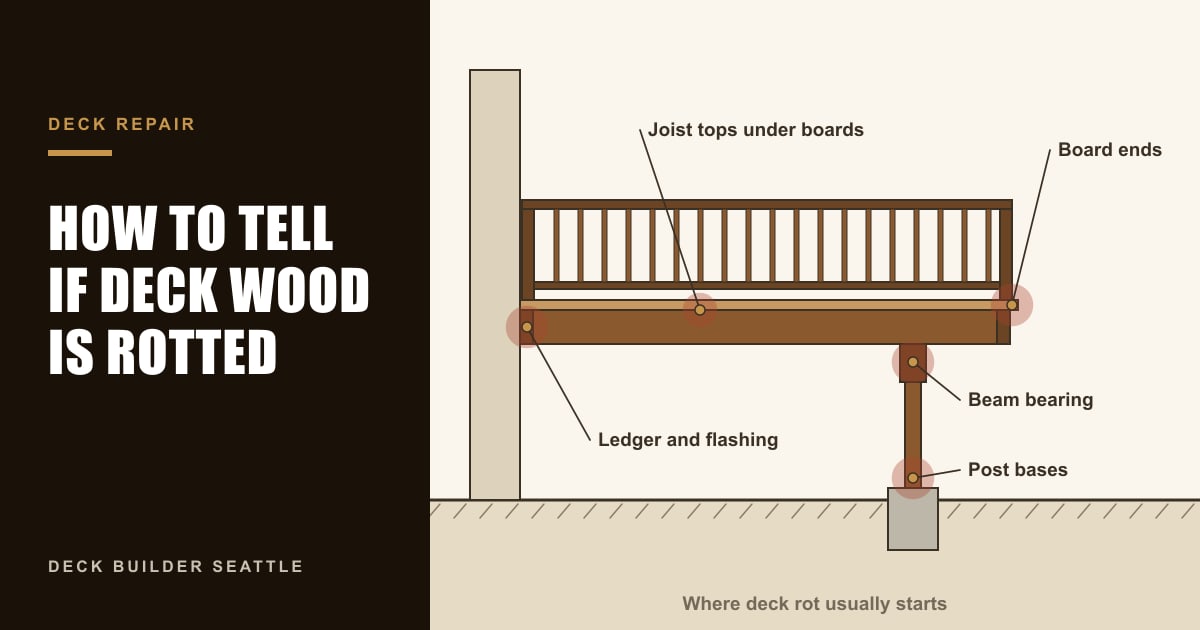
How to tell if deck wood is rotted comes down to one test: press on it. Sound wood is hard and springs back. Rotted wood is soft, gives under light pressure from a screwdriver tip, and breaks into short crumbly pieces instead of long splinters. Discoloration, cracking, and green or black growth are clues that point you to where to check, but softness is what confirms decay.
Rot matters because of where it tends to occur. It is most common at the connections and framing that hold the deck up, in spots that stay wet and out of sight.
This guide covers the signs of deck rot, where to look first, how to probe wood without damaging it, and what the common terms “wet rot” and “dry rot” really mean.
What rot is, and why Seattle decks get it
Wood rot is decay caused by fungi that digest the wood itself. The fungi need three things: wood, mild temperatures, and water.
Water is the one you can control. According to the U.S. Forest Service’s Wood Handbook, serious decay occurs only when the moisture content of wood is above the fiber saturation point, which averages about 30 percent. Fully air-dried wood, usually at or below 20 percent, will not decay, and existing decay will not progress while the wood stays dry.
That explains the pattern on decks. Rain alone is not the problem, since a board that gets wet and dries within a day stays sound. Decay sets in where water is trapped and the wood cannot dry: between a board and the joist under it, behind a ledger, inside a post base packed with debris.
Seattle’s climate makes drying slow. Months of frequent rain, mild winter temperatures, shade from tall trees, and moss that holds water against the wood all extend the time wood stays above that threshold.
Signs of deck rot
Softness
This is the most reliable sign. Decayed wood loses its hardness well before it falls apart. It feels spongy underfoot, dents under thumb pressure, or gives when probed.
Crumbling fibers
Healthy wood breaks into long, stringy splinters along the grain. Decayed wood breaks across the grain into short pieces. In advanced brown rot, which is the type most common in softwoods such as fir, hem-fir, and cedar, the wood turns brown, shrinks, and cracks into small cubes that crush to powder.
Discoloration
Look for areas that are darker than the surrounding wood, or that have a bleached, stringy look. Color by itself is not proof. Gray is normal sun weathering, and dark staining around fasteners can be a reaction between metal and the wood. Treat discoloration as a reason to check for softness.
Persistent moisture
Wood that still looks dark and wet a day or two after the rest of the deck has dried is staying above the moisture level where decay can grow. Mark those spots. If they are not soft yet, they are next.
Fungal growth
Mushrooms or shelf-like fungi growing from deck wood are the fruiting bodies of decay fungi and mean decay is established inside. White or yellowish cottony or thread-like growth on the underside of boards or framing is also a sign.
Surface mildew, green algae, and moss are different. They live on the surface and do not consume the wood. They do hold moisture, so they are a warning about conditions.
Cracking around fasteners
Every screw and nail hole is a path for water into the board and into the joist below. Look for dark rings around fasteners, fasteners that have lifted or spin freely, and cracks radiating from them. A screw that no longer holds often means the wood beneath it has softened.
Deterioration at board ends
End grain absorbs water much faster than the face of a board. Rot commonly starts at the ends of deck boards, at butt joints where two boards meet over a joist, and at the cut ends of stair treads and railing parts.
Damage around the ledger connection
The ledger is the board that attaches the deck to the house. Look at the joint between the deck and the wall. Missing metal flashing above the ledger, dark staining on the ledger or on the siding below it, and soft wood where the joists meet the ledger are all significant findings.
Rot at joist tops
Joists are the framing members under the deck boards. Their top edges sit directly under the gaps between boards, where water and debris collect. From below, a joist can look clean on its sides while the top inch has softened. Look for dark streaks running down from the top edge and for fasteners that have lost their grip.
Decay around posts
Posts rot where they meet the ground or sit in a base that holds water. Check the bottom few inches of each post, the area where a post is notched to hold a beam, and any post that is buried in soil or concrete.
Where to look first
If you have ten minutes, check these in order. They are the places where rot is most consequential.
- The ledger and the wall just below it
- The base of each post
- The ends of the joists where they meet the ledger and the beam
- Stair stringers where they touch the ground, and the stair treads
- The base of railing posts
- Board ends and butt joints
- Anywhere under a planter, a mat, or furniture that stays put
The screwdriver test for rot
The probe test is simple, and it is easy to overdo. The goal is to compare how the wood responds. It is not to see how far a tool can be driven in.
- Use a flat screwdriver or an awl.
- Press the tip against the wood with moderate hand pressure, about what you would use to push a thumbtack into a cork board.
- On sound wood, the tip barely marks the surface.
- On decayed wood, the tip sinks in with little resistance, often a quarter inch or more, and the wood feels soft or stringy as the tool comes out.
- For a second check, press the tip in at a shallow angle and lever up a small sliver. Sound wood lifts a long splinter. Decayed wood breaks off short across the grain.
Compare suspect spots with wood you know is good, such as a dry area in the middle of a board. The difference is usually obvious.
Some cautions:
- Do not stab, hammer, or pry at joists, beams, posts, or the ledger. A few light probes are enough, and each hole you make is a new entry point for water.
- Do not remove boards, hardware, or trim to get a better look at the framing.
- Do not crawl under a deck that is sagging, leaning, or pulling away from the house.
- If structural wood is soft, stop there. You have learned what you need to know, and the next step is an assessment.
A firm surface does not rule out every problem. Large timbers can decay inside while the outer shell stays hard, especially posts. A post that sounds hollow when tapped, or has soft wood at a crack or a bolt hole, should be checked by a professional.
Wet rot vs dry rot on a deck
These two terms are everywhere, and they cause confusion.
In everyday use, “wet rot” means decay in wood that is visibly wet, and “dry rot” means brown, cracked, crumbly wood that is dry when you find it. People often treat them as two diseases with different cures.
The science is simpler. All wood decay requires moisture. The Wood Handbook states that the term dry rot is incorrect, because wood must have available moisture for decay, although it may become dry later. Wood described as dry rot was wet when it decayed.
The categories wood scientists use are these:
- Brown rot removes the cellulose that gives wood its strength. The wood darkens, shrinks, and cracks across the grain into cubes. This is the typical decay in softwood decks, and it causes large strength loss early.
- White rot removes both lignin and cellulose. The wood looks bleached and feels spongy or stringy without the cubical cracking. It is more common in hardwoods.
- Soft rot is a shallower surface decay caused by different fungi, often seen on wood that is wet for long periods.
Some brown-rot fungi found in buildings can move water through root-like strands to reach drier wood, which is part of the origin of the dry rot name. They still need a water source.
For a homeowner, the label matters less than two facts. The wood was wet for a long time, and the decayed part has lost its strength. The fix is the same: remove the damaged wood and stop the water.
How to tell if deck wood is rotted or only weathered
Several conditions look alarming and are not decay.
| What you see | Likely cause | Structural concern? |
|---|---|---|
| Gray, slightly rough surface | Sun weathering | No |
| Green film or black spots that wash off | Algae or mildew | No, but shows the wood stays damp |
| Small cracks along the grain | Normal drying checks | Usually no |
| Moss between boards | Trapped moisture and debris | Not itself, but it promotes decay |
| Dark stains around nails or screws | Metal reacting with wood, or early moisture damage | Probe to find out |
| Soft, crumbly, or stringy wood | Decay | Yes |
When in doubt, the probe test settles it.
Why staining over rotted wood does not work
It is tempting to clean the deck, apply a fresh coat of stain, and call it handled. On sound wood, that is good maintenance. On decayed wood, it only changes the color.
Stain and sealer are surface treatments. They cannot rebuild wood fibers that fungi have consumed, so the board or joist is exactly as weak as it was before. A fresh finish also hides the discoloration that marked the problem area, and a film-forming coating over damp wood can slow its drying.
Wood hardeners and epoxy fillers have a place on trim, window sills, and decorative parts. They are not a structural repair for joists, beams, posts, or ledgers.
If you are planning to refinish, check for rot first and replace what is soft.
How to stop deck rot
Decay stops when the wood dries and stays dry. Prevention is about drainage and drying.
- Keep the gaps between boards clear so water and debris fall through
- Move planters onto stands, and move mats and furniture periodically
- Keep soil, mulch, and vegetation away from posts and framing
- Make sure downspouts and sprinklers do not discharge onto the deck
- Confirm there is flashing over the ledger that directs water away from the wall
- Trim back plants that block airflow under the deck
- Clean off moss and algae, and maintain the finish on wood decking
- Replace decayed pieces promptly, since wet, decayed wood keeps neighboring wood wet
When wood is replaced, the cause should be addressed at the same time. A new board installed over the same clogged gap will go the way of the old one.
What to do if you find rot
What happens next depends on where the rot is.
In deck boards, treads, or railing parts: these are replaceable. Block off any section that is unsafe to walk on, and plan to replace the affected pieces. Look at the framing underneath when the boards come up.
In joists: this is structural. Our guide to rotted deck joists explains how severity is judged and what the repair options are.
In the ledger, beams, or posts: keep people off the deck until it has been assessed. These members carry everything else. The deck safety checklist covers the other warning signs to check at the same time.
For a sense of what different repairs run, see our deck repair cost guide.
If the screwdriver sank into something structural, the practical next step is to have the framing looked at from below and probed properly. Our deck repair service in Seattle page describes how we assess decay and how we decide what can be repaired and what should be replaced.
Frequently Asked Questions
Can rotted deck wood be repaired, or does it have to be replaced?
Rotted wood cannot be restored to its original strength. Decking boards, railing parts, and stair treads with rot are replaced. Framing with limited rot can sometimes be reinforced by fastening a new member alongside it, but the decayed portion is not doing structural work anymore. Fillers and epoxy consolidants are cosmetic repairs for trim and non-structural pieces.
Is black or green discoloration on my deck rot?
Usually not by itself. Green film is algae, black spotting is typically mildew or mold, and gray color is weathering from sunlight. All of these live on the surface and wash off. They do tell you the wood is staying damp, which is the condition decay needs. Rot is confirmed by softness and loss of structure, not by color alone.
Does pressure-treated wood rot?
It resists decay far longer than untreated wood, but it can rot. Preservative does not always penetrate to the center of a large piece, so cut ends, drilled holes, and notches expose less-protected wood unless they are treated on site. Lumber rated only for above-ground use will also decay early if it is used in contact with soil or kept constantly wet.
How fast does deck rot spread?
There is no fixed rate. Decay progresses while the wood stays wet and is warm enough for fungi to grow, and it stops when the wood dries out. A spot that stays saturated can go from firm to soft within a few years, while a well-drained area on the same deck stays sound for decades. Removing the source of moisture is what halts it.
Will rot in my deck spread to my house?
Decay does not jump across dry wood, but the water that caused it can affect both structures. The usual link is the ledger. If flashing is missing and water has been running behind the ledger, the house's rim framing and sheathing may be wet too. Staining or softness on the wall below the ledger is a reason to have that connection inspected.
Found soft or crumbling wood? Our Seattle deck repair page explains how we assess rot and what can be repaired.
Deck repair service or call (425) 928-1172