
Deck Staining Cost and Refinishing Cost in Seattle (2026)
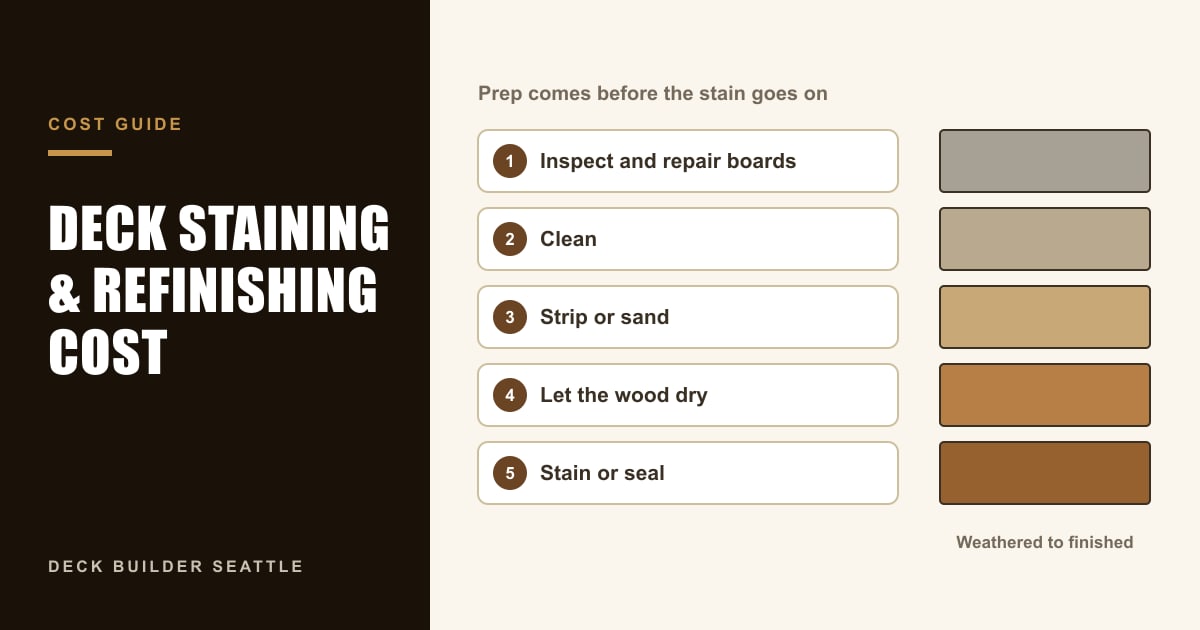
Deck staining cost in Seattle typically runs $4 to $7 per square foot in 2026 for professional cleaning and staining of a wood deck in fair condition. For a 300 square foot cedar deck, that is about $1,200 to $2,200. Decks that need sanding or stripping first cost more, commonly $6 to $14 per square foot, and hardwood decks cost more again.
These are planning estimates based on our 2026 pricing. They are not quotes. The final figure depends on the deck’s size, its railings and stairs, and above all on the condition of the existing finish.
That last point surprises most homeowners. The stain itself is a small part of the bill. Preparation is where the hours go, and it decides whether the finish lasts.
Cleaning, staining, sealing, sanding, and refinishing
These words get used interchangeably, but they describe different jobs with different prices.
Cleaning removes dirt, mildew, algae, and loose gray wood fibers using a deck cleaner and a low-pressure rinse. Every staining job starts with it.
Sealing applies a clear or lightly tinted water repellent. It slows water absorption but gives little protection against sunlight.
Staining applies a pigmented finish that adds color, blocks ultraviolet light, and repels water.
Sanding removes weathered surface wood and the remains of old finish, leaving fresh wood for the new coating to bond to.
Stripping uses a chemical remover to take off an old coating, usually a failed solid stain or paint, before sanding.
Full refinishing combines them: strip or sand to bare wood, repair, then stain. It returns a neglected deck to like-new appearance.
Cost to stain a deck per square foot
The table shows 2026 planning ranges for Seattle, measured by the square footage of the deck floor.
| Service | What it includes | Per sq ft | 300 sq ft deck |
|---|---|---|---|
| Cleaning only | Deck cleaner, mildew treatment, rinse | $0.75 to $1.50 | $225 to $450 |
| Clean and seal | Cleaning plus a clear water repellent | $3 to $5 | $900 to $1,500 |
| Clean and stain | Cleaning, light prep, one or two coats of stain | $4 to $7 | $1,200 to $2,200 |
| Sand and stain | Cleaning, full sanding, stain | $6 to $10 | $1,800 to $3,000 |
| Strip, sand, and stain | Removing a failed coating, sanding, stain | $8 to $14 | $2,400 to $4,200 |
| Hardwood refinishing | Sanding and oiling ipe or similar hardwood | $11 to $17 | $3,300 to $5,100 |
Railings and stairs are usually priced on top of the floor area. Railings typically add $6 to $16 per linear foot, depending on the style and whether they need stripping. A deck with a long baluster railing can take as much labor as the floor itself.
National cost guides often quote lower figures, in the range of $2 to $5 per square foot. Seattle labor rates are higher, and decks here tend to need more preparation because of mildew, moss, and long wet seasons.
Deck sealing cost
Clear sealing costs slightly less than staining because the product is cheaper and application is forgiving. Expect $3 to $5 per square foot with cleaning included.
The saving is modest, and the protection is shorter-lived. Clear sealers have little pigment, so sunlight still breaks down the wood surface and the deck grays. Many clear products need reapplication every year. A semi-transparent stain usually gives better value over several years.
Deck sanding and staining cost
Sanding adds roughly $2 to $4 per square foot to a staining job. It is needed when the surface is rough, gray, and fibrous, when an old finish is worn unevenly, or when the boards have raised grain and splinters.
Sanding a deck is slower than sanding a floor indoors. Fasteners have to be set below the surface first, edges and corners are done by hand, and railings cannot be sanded by machine at all.
There are limits. Sanding removes wood, so thin or badly cupped boards may be better replaced. And sanding does nothing for boards that are soft from decay.
Deck refinishing cost
Full refinishing is the top of the range: $8 to $14 per square foot for softwood decks with a failed coating, and more for dense hardwoods.
The expensive case is a deck that was coated with a solid stain or paint that is now peeling. That coating has to come off completely. Chemical stripper softens it, a careful rinse removes it, a brightener restores the wood’s color, and sanding takes care of what remains. Each step needs drying time before the next.
If the deck also needs boards replaced, the job becomes a restoration. For a 300 square foot deck, restoration with board replacement, sanding, and stain typically runs $2,800 to $8,500 depending on how many boards are changed and the wood species.
What drives the price up or down
Deck square footage. Larger decks cost more in total and somewhat less per square foot, because setup and cleanup are spread over more area.
Railings. Balusters are slow. Every face of every picket is brushed or sprayed and back-brushed. Solid panels, cable, and metal railings that need no finish reduce the cost.
Stairs. Treads, risers, and stringers have many edges and are finished mostly by hand.
Existing coating condition. A sound, worn finish can be cleaned and recoated. A peeling or flaking one must be removed. This is the largest single swing in price.
Prep requirements. Heavy mildew, moss, embedded dirt, rust stains from furniture, and tannin stains each add steps.
Board condition. Loose, cracked, or rotted boards need to be replaced before finishing. Popped nails and raised screws need to be reset.
Stain type. Higher-pigment and premium products cost more per gallon. Dense hardwoods need specific penetrating oils.
Accessibility. Second-story decks, decks surrounded by planting beds, and decks over finished patios take longer to protect and work around.
Why preparation affects price more than you expect
On a typical job, applying the stain takes less time than everything that comes before it. A finish fails for one of three reasons, and all three are prep problems.
The wood was dirty. Stain applied over mildew, dirt, or loose gray fibers bonds to that layer, not to sound wood. It comes off when the layer does.
The old finish was not compatible. A penetrating stain cannot soak into wood that is still sealed by an old film. A new film applied over a failing one peels with it.
The wood was wet. Stain needs dry wood to penetrate or adhere. Moisture trapped under a film-forming finish pushes it off from below.
A low bid often means a quick wash and one coat. That can look good for a season. Paying for proper cleaning, drying time, and surface preparation is what makes a finish last its expected life.
Seattle weather and timing
Moisture matters here for a specific technical reason. Stain manufacturers set a maximum moisture content for the wood at application, and they require a period of dry weather before and after. Those conditions are on the product label, and they are hard to meet in Seattle for much of the year.
In practice, most exterior staining here happens from late spring into early fall. After washing, a deck generally needs a few dry days before it can be coated, and the forecast needs to stay dry while the finish cures.
Two consequences follow. Scheduling is tight in summer, so booking early helps. And a contractor willing to stain in damp conditions to keep a schedule is not doing you a favor.
Shade affects longevity too. A deck under trees or on the north side of a house stays damp longer, grows mildew faster, and usually needs maintenance sooner than one in full sun.
Choosing a stain type
The choice affects both cost over time and appearance.
| Type | Look | Typical trade-off |
|---|---|---|
| Clear sealer | Natural, wood still grays | Shortest life, little sun protection |
| Transparent or toner | Light tint, full grain visible | Short life, easy to recoat |
| Semi-transparent | Color with grain showing | Good balance, wears away gradually |
| Semi-solid | Mostly color, some grain | Longer life, hides flaws |
| Solid | Opaque like paint | Longest initial life, can peel and then needs stripping |
For deck floors in a wet climate, penetrating semi-transparent stains are a common recommendation because they wear away gradually and can be cleaned and recoated without stripping. Solid stains hide weathered wood well, but when they fail on a horizontal surface they fail by peeling.
Stain does not fix structural problems
Before paying for a finish, make sure the deck is worth finishing. Staining improves appearance and slows weathering. It does not repair decayed wood.
Stain applied over soft, rotted boards hides the discoloration that would have warned you. Our guide on how to tell if deck wood is rotted explains how to check boards before they are coated.
Look past the surface as well. If the deck has loose railings, soft stair treads, or movement in the frame, deal with those first. The deck safety checklist covers what to inspect. There is little point in refinishing boards that will be torn out for a structural repair next year.
Getting an accurate staining quote
A useful quote is based on a look at the deck, and it should state:
- The square footage of the floor and the length of railing included
- Exactly what preparation is included: cleaning, stripping, sanding, brightening
- The product and the number of coats
- Whether board replacement and fastener resetting are included or priced separately
- How weather delays are handled
If you would like the deck assessed and priced, our deck staining service in Seattle page describes the prep steps we follow and the products we use.
Frequently Asked Questions
How often does a deck need to be stained in Seattle?
Plan on every two to three years for the walking surface of a cedar or pressure-treated deck, with a cleaning in between. Railings and other vertical surfaces last longer because water runs off them. Shaded decks and those under trees may need attention sooner. A simple check is to sprinkle water on the boards: if it soaks in and darkens the wood instead of beading, the finish is worn.
Is it cheaper to stain a deck yourself?
In materials, yes. Stain, cleaner, brushes, and a sander rental cost a few hundred dollars for an average deck. The real cost is time and the risk of prep mistakes: staining over damp wood, skipping the cleaning, or applying too much product are the usual reasons a finish peels within a year. Stripping a failed finish costs more than the original job would have.
What is the difference between deck stain and deck sealer?
A clear sealer repels water but contains little or no pigment, so it gives almost no protection from sunlight and the wood still turns gray. A stain contains pigment, which blocks ultraviolet light and adds color, and most deck stains also repel water. More pigment generally means longer protection and less visible grain.
Can composite decking be stained?
Modern capped composite and PVC boards are not designed to be stained and do not need it. They are cleaned with soap and water. Some older uncapped composite boards can be coated with products made for that purpose, but results vary. Check the decking manufacturer's care instructions before applying anything, because the wrong product can void the warranty.
Should a new deck be stained right away?
Usually not on the day it is built. New lumber, especially pressure-treated wood, often holds a lot of moisture and needs time to dry before it will accept a finish. Follow the stain manufacturer's instructions, which typically call for the wood to be dry to a stated moisture content. In practice that can mean waiting several weeks in dry weather.
Want a firm price for your deck? Our Seattle deck staining page explains our prep process and what a quote includes.
Deck staining service or call (425) 928-1172