
Deck Replacement Cost: Removal, Rebuild, and Resurfacing Prices in Seattle
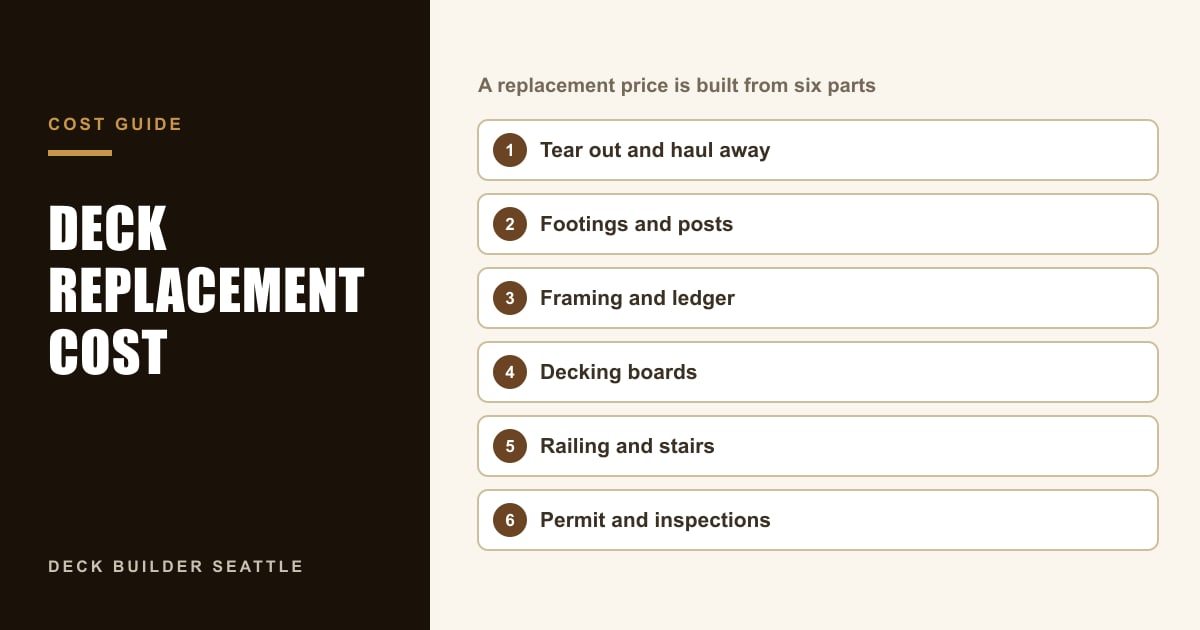
Deck replacement cost in Seattle typically runs from $14,500 to $34,000 for a 300 square foot deck in 2026, including removal of the old deck. Cedar replacements commonly fall between $14,500 and $22,000, and capped composite between $22,000 and $34,000. Large, tall, or multi-level decks in premium materials can reach $58,000 or more.
Those are planning ranges based on our own projects this year. Your price depends on the deck’s height, the site, the materials, and how much of the existing structure has to go.
Replacing a deck is more than installing new decking. It is a demolition job followed by a construction job, usually with a permit in between. This guide breaks the price into its parts and compares full replacement with the two smaller options: resurfacing and a partial rebuild.
What deck replacement cost includes
A complete replacement quote should account for each of these.
| Cost component | What it covers | What drives it |
|---|---|---|
| Removal and demolition | Taking apart decking, railing, stairs, framing, and posts | Size, height, how it was fastened, attached structures |
| Debris disposal | Hauling and dump or recycling fees | Volume, treated lumber, concrete, distance to the truck |
| Footings and posts | New concrete footings and posts, or verification of existing ones | Soil, slope, deck height, number of posts |
| Framing | Ledger, flashing, joists, beams, hardware | Deck size and span, the 60 psf design load, joist spacing for the decking |
| Decking material | The walking surface and fasteners | Material and grade, pattern, borders, hidden fasteners |
| Railing | Guard posts, rails, and infill | Length, type, height of the deck |
| Stairs | Stringers, treads, landing, handrails | Height to climb, width, materials |
| Permits | Drawings, SDCI fees, inspections | Deck height and size, critical areas, plan review type |
| Labor | Crew time for all of the above | Complexity, access, weather |
| Access | Getting materials in and debris out | Side yard width, stairs, slope, parking |
| Design changes | A different size, shape, height, or layout | Engineering, new footings, zoning limits |
On a full replacement, the framing, decking, and labor make up most of the total. Railings and stairs are the next largest pieces, and they vary the most from one deck to another.
Deck removal cost and deck demolition cost
Demolition is the first line of a replacement quote. For a typical residential deck in Seattle, removal and disposal run $800 to $2,500 in 2026.
Several things move a deck within that range, or past it:
- Height. A second-story deck has to be taken down in a controlled sequence, often with temporary support
- Construction. Decks assembled with screws and hardware come apart more slowly than nailed ones
- Concrete. Breaking out and hauling old footings or a slab adds labor and heavy disposal
- Access. If everything is carried by hand through a narrow side yard, hours add up
- Attachments. Pergolas, built-in benches, hot tubs, and electrical all need to be disconnected and removed
- Protection. Plantings, windows, and siding near the work need to be shielded
Demolition is also when the condition of the house wall is revealed. Once the old ledger is off, any water damage to the siding, sheathing, or rim framing behind it becomes visible and has to be repaired before a new ledger goes on.
Cost to rebuild a deck: the new structure
Once the old deck is gone, the cost to rebuild is essentially the cost of a new deck on the same site.
Footings and posts
New footings are sized from the deck’s loads and the soil. Washington requires decks to be designed for a 60 pound per square foot live load, which is higher than the national model code and results in larger footings than many older decks have.
Reusing existing footings can save money, but only if they are adequate. They have to be the right size, at least 12 inches below undisturbed ground in Seattle, in good condition, and located where the new beam layout needs them. If the new deck is larger, taller, or shaped differently, new footings are usually required.
Framing
Framing includes the ledger at the house, the joists, the beams, and all the metal hardware that connects them. A replacement is the chance to do the parts that matter most for long life: proper flashing above the ledger, structural fasteners into the house, hold-down hardware, and corrosion-resistant connectors.
If you are moving from wood decking to composite or PVC, the joist spacing has to match the manufacturer’s installation requirements, which is often 16 inches on center or closer.
Decking, railing, and stairs
These are the visible choices, and they account for most of the difference between a lower and a higher replacement price. Cedar decking costs less than capped composite, which costs less than PVC or tropical hardwood. Railing ranges from wood at roughly $45 to $75 per linear foot installed to glass at $150 to $250 or more.
Stairs are priced by the height they climb. Replacing a deck is also when stairs get rebuilt to current dimensions for risers, treads, landings, and handrails.
Permits for a replacement deck
In Seattle, a deck more than 18 inches above grade needs a building permit, and rebuilding one is new construction. A like-for-like footprint does not exempt it.
Most replacement decks qualify for the simpler subject-to-field-inspection permit. A deck more than 8 feet above the ground, over 750 square feet, on a roof, or in an environmentally critical area needs full plan review. SDCI fees are based on project value. For a deck valued between $12,000 and $28,000 on the simpler permit, city fees come to roughly $750 to $1,150 under the 2026 fee table.
Zoning applies as well. If the old deck sat inside a setback or pushed the lot over its coverage limit, the replacement may not be allowed in exactly the same place. That is worth checking before design begins. Our Seattle deck permit guide covers the thresholds, setbacks, and fees.
Resurfacing, partial rebuild, or complete replacement
Full replacement is one of three paths. The right one depends on the condition of the frame.
| Approach | What stays | What is new | Planning range, 300 sq ft deck (2026) |
|---|---|---|---|
| Resurfacing | Footings, posts, beams, joists, ledger | Decking, usually railing and stair treads | $6,000 to $15,000 for decking, plus railing |
| Partial rebuild | Footings and posts, sometimes beams | Joists or ledger as needed, decking, railing, stairs | $10,000 to $22,000 |
| Complete replacement | Nothing | Everything, from footings up | $14,500 to $34,000 |
Deck resurfacing cost
Resurfacing, also called re-decking, means removing the old boards and installing new ones on the existing frame. It typically runs $20 to $50 per square foot, depending on the material. New railing is priced separately by the linear foot.
It is the most economical way to get a deck that looks and feels new. It also carries a condition that cannot be skipped.
Why reusing framing only saves money when the framing is suitable
Keeping the frame lowers the price because you avoid demolition, footings, and framing lumber and labor. That saving holds only if the frame will last as long as what you attach to it.
A frame is suitable for reuse when:
- Joists, beams, and the ledger are free of decay, including along the top edges that are hidden until the old boards come off
- The ledger is properly flashed and fastened to the house
- Joist spacing matches what the new decking requires
- The frame is flat and level, with no sagging or twisted members
- Posts are sound at the base and the footings have not settled
If any of those fail, the choices are to repair the frame first, which adds cost, or to rebuild. New composite boards often carry warranties of 25 years or more. Installing them over joists with a decade of life left means paying to remove and reinstall the surface later.
There is a second cost risk. The top edges of the joists are not visible until the decking is removed, so a resurfacing quote can change mid-project. A good quote states what happens if hidden damage is found and gives a unit price for each joist that needs to be reinforced or replaced.
Partial rebuild
A partial rebuild keeps the parts of the structure that are still sound, typically the footings and posts, and replaces the rest. It suits a deck where the foundation is good and the layout works, but the joists or ledger have failed.
It costs less than full replacement because excavation and concrete are avoided. It makes less sense when the footings are undersized for the current code or when you want to change the deck’s size or height.
What makes one replacement cost more than another
Two homeowners replacing decks of the same size can receive very different quotes. The usual reasons:
- Height. A second-story deck costs far more to demolish and rebuild than a low one
- Material. The spread between cedar and premium PVC or hardwood is large
- Railing type and length
- Stairs, especially long flights with landings
- Hidden damage to the house wall behind the old ledger
- Design changes, such as a larger footprint, a new level, or a relocated stair
- Site access and slope
- Permit type, engineering, and drawings
If your quotes differ widely, ask each contractor to break the price into the components in the first table. The differences are usually in scope.
Is replacement the right choice?
Before committing to replacement, confirm that the smaller options have been ruled out for good reasons. If the frame is healthy, resurfacing may give you most of what you want for much less. If the damage is confined to one area, a repair may be enough, and our deck repair cost guide shows what those run.
Replacement is the better investment when structural problems are widespread, when the deck was underbuilt, or when you want a different deck from the one you have. The guide on whether to repair or replace a deck lays out that decision step by step.
Getting a replacement priced
A reliable replacement price needs a site visit. The contractor should look at the existing structure, measure heights and setbacks, check access, and ask what you want to change.
Ask for a written quote that lists demolition, footings, framing, decking, railing, stairs, and permits separately, and that says what is assumed about the house wall behind the ledger.
If you are at that stage, our deck replacement service in Seattle page explains how tear-out, permitting, and construction are sequenced and what the quote covers.
Frequently Asked Questions
How much does it cost to remove a deck without replacing it?
Deck removal on its own typically costs $800 to $2,500 in Seattle in 2026 for an average residential deck, including hauling and disposal. Second-story decks, decks with concrete footings that must be broken out, and sites with no vehicle access cost more. You will also need to deal with what is left: the door that opened onto the deck, the siding where the ledger was attached, and the ground below.
Is it cheaper to resurface a deck than to replace it?
Yes, when the frame qualifies. Resurfacing typically runs $20 to $50 per square foot, compared with a full replacement that includes demolition, footings, and new framing. The saving is real only if the existing joists, beams, ledger, posts, and footings are sound and suit the new decking. Resurfacing a frame that fails a few years later costs more in total than replacing it once.
Can the old footings be reused when a deck is replaced?
Sometimes. Existing footings can be reused if they are large enough for the new deck's loads, deep enough, undamaged, and positioned where the new posts need to be. Washington now requires decks to be designed for a 60 pound per square foot live load, and many older footings were sized for less. They have to be exposed and measured before anyone can say.
Does deck replacement add value to a house?
A sound, attractive deck helps a house sell, and a failing one shows up on inspection reports and in negotiations. How much of the cost comes back at resale varies by year, neighborhood, and the rest of the house, so treat any single percentage with caution. The stronger argument is use and safety: you get a deck you can rely on for the years you own the home.
How long does a deck replacement take?
On site, a typical single-level replacement takes one to three weeks once work starts, depending on size, height, and weather. The calendar time is longer because of design, permitting, material lead times, and scheduling. Starting the planning well ahead of the season you want to use the deck is the best way to control the timeline.
Ready to price a tear-out and rebuild? See what our Seattle deck replacement service includes, from demolition to final inspection.
Deck replacement service or call (425) 928-1172